Teaching children about money in Nigeria is one of the most important things a parent can do, yet many families avoid the topic entirely. Money was considered adult business in past generations, but with digital payments, OPay transfers, and cash gifts arriving through links and PINs, children now see money moving in ways their parents never did at their age. The good news is that you do not need a finance degree or a complicated curriculum. Age-appropriate lessons, consistent habits, and open conversations are all it takes to raise children who understand saving, spending, and generosity in the Nigerian context. This guide covers practical lessons by age group, the role of allowances, and how digital tools like Goodiebag fit into financial education.
Why Nigerian Children Need Financial Education
Many Nigerian parents grew up in homes where money was never discussed. It was considered rude for children to ask about finances. Parents shielded kids from money conversations, believing it was adult business. This cultural taboo has real consequences. EFInA's 2023 financial inclusion research shows why deliberate financial education still matters for Nigerian households. Without deliberate teaching at home, children grow into adults who struggle with saving, budgeting, and investing. The Federal Ministry of Education does not mandate financial literacy as a standalone subject in most Nigerian schools. That means the responsibility falls entirely on parents. This guide walks you through teaching financial literacy for kids in Nigeria, broken down by age group, with practical exercises you can start today.
Age-Appropriate Financial Lessons for Nigerian Kids
Children understand money differently at each age. The lesson you teach a three-year-old about naira notes is completely different from what you teach a teenager about OPay transfers. Match the lesson to what the child can actually understand.
Ages 3-5: Identifying Naira Notes and Coins
At this age, children learn through touch, sight, and play. They are not ready for abstract concepts like budgeting or saving for the future. What they can do is recognize different naira notes and understand that money is used to buy things. Start by showing them the different colours and denominations. Let them hold a ₦50 note, a ₦100 note, a ₦200 note, a ₦500 note, and a ₦1,000 note. Point out the differences. Teach them that a ₦1,000 note buys more than a ₦100 note. A simple game: scatter a mix of notes on the table and ask them to group matching denominations together. Another exercise is pretend shopping. Use old food packaging and price each item in naira. Give your child a small stack of fake naira notes (or real ones under supervision) and let them buy items from you. They learn that money is exchanged for goods. They also learn that once the money runs out, they cannot buy anything else. This is their first exposure to scarcity, and it is a powerful lesson.
Ages 6-10: Saving in a Kolo or Piggybank
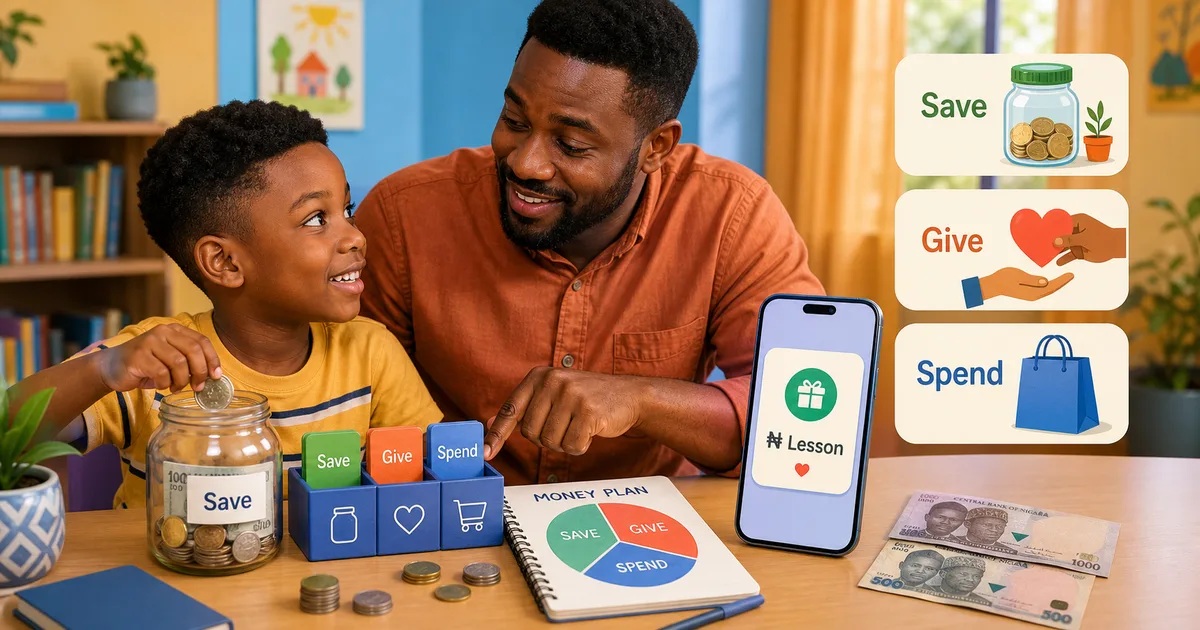
This is the age where saving starts to make sense. Nigerian parents have used the kolo, a traditional clay pot with a small slit for coins, for generations. Today, a piggybank can do the same job. Make saving visible. Give your child a clear jar or piggybank and let them decorate it. If they want a ₦3,000 toy, draw 30 squares representing ₦100 each. Every time they save ₦100, they colour in a square. During Sallah or Christmas, help them divide gift money into saving, spending, and giving.
Ages 11-14: Earning Through Chores and Budgeting
Pre-teens can start learning that money is earned, not simply handed out. You can attach small naira values to household chores. Making the bed every morning might be ₦100 per week. Washing dishes after dinner might be ₦200 per week. Helping with Saturday market runs might be ₦500. At the end of the week, pay the earned amount and help them budget it in three columns: Money In, Money Out, Money Left. This is also a good age to teach needs versus wants. Data for school research is a need. Extra data for TikTok is a want.
Ages 15+: Digital Money, Bank Accounts, and Fintech for Teens
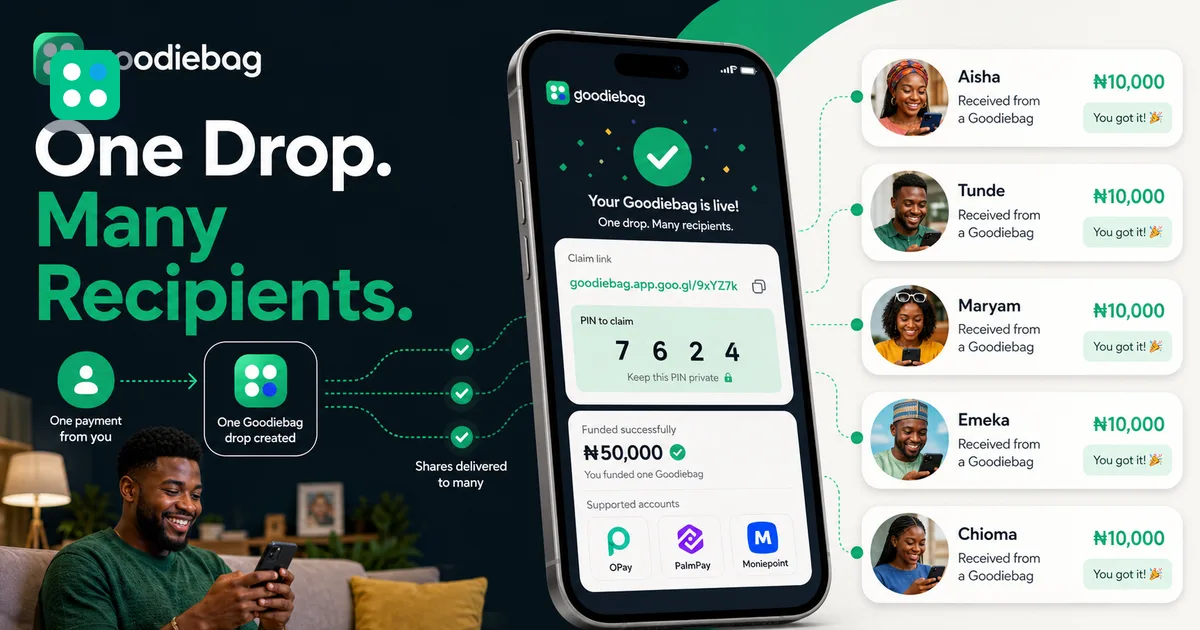
Teenagers live in a digital world. They order food on Chowdeck, pay for data on their phones, and see parents transfer money via OPay and PalmPay every day. Teaching them about digital money is not optional. It is essential. At this age, they can understand the full cycle of digital financial services. Open a discussion about how money moves from one phone to another. Explain that behind every OPay transfer, there is a bank code (999992) and an account resolution system that links phone numbers to accounts. Show them how Goodiebag works: someone creates a money packet, and recipients claim with just their phone number. This introduces the concept of pass-through payments. If your teen is 16 or older, you can open a bank account in their name. Many Nigerian banks offer teen accounts with parental supervision. Explain how interest works on savings. Use a simple example: if they save ₦50,000 at 5% annual interest, they earn ₦2,500 in a year without doing anything. That is the magic of compound interest, and it is never too early to learn it.
Create your first Goodiebag
Create a money packet in under 2 minutes. One link. One PIN. Everybody paid.
Create a GoodiebagUsing Allowances to Teach Money Management
An allowance is one of the most effective tools for teaching children about money, but only if it is structured properly. A random ₦500 whenever your child asks is not an allowance. It is a handout, and it teaches nothing. A proper allowance has three characteristics: it is regular, it is tied to age-appropriate expectations, and it comes with clear rules. For primary school children, a weekly allowance of ₦500 to ₦1,000 works well. For secondary school students, a monthly allowance of ₦3,000 to ₦5,000 gives them more room to practice budgeting. The rule should be: once the money is gone, it is gone until the next allowance day. Do not give advances. Do not bail them out if they spent everything on snacks by Wednesday. This is how they learn financial discipline. The stakes are low when they are young. A ₦500 mistake at age 8 is a learning experience. A ₦500,000 mistake at age 28 is a crisis.
The Sallah Money Tradition: A Real Nigerian Example
Every Nigerian child knows the excitement of Sallah morning. After Eid prayers, relatives visit the house, and each one presses some naira notes into small hands before the children can say Mubarak. The visiting uncles and aunties might give ₦200, ₦500, or ₦1,000 each. By the end of the day, a child could have ₦3,000 to ₦5,000 in gift money. This is a perfect teaching moment. Instead of letting the child spend it all on sweets and toys in one week, use the Sallah money as a financial lesson. Help them split it into the three categories: save a portion, spend a portion, and give a portion. The giving part can be meaningful. Ask your child to pick one or two people in the family who might not have received as many Sallah visitors. Let them gift some of their money to those relatives using Goodiebag. This turns a simple tradition into a lesson about saving, spending, and generosity.
Using Goodiebag to Teach Children About Money
Goodiebag can also help parents talk about digital money and generosity, but it should be used thoughtfully. For older children with parent-approved accounts, a small allowance or Children's Day gift can become a teaching moment. For younger children, parents or guardians should receive and manage the money. The lesson is not that every child needs a fintech account. The lesson is that money can be planned, received safely, and used generously.
Teaching Generosity Through Goodiebag
Financial literacy is also about giving. Nigerian culture places a high value on community support and generosity. Involve children in family Goodiebag drops where appropriate. When you create a Goodiebag for a family milestone, explain why you are giving and ask whether they want to add a small part of their savings. Even ₦500 can help a child feel the pride of contributing.
Read Also
Common Mistakes Parents Make
Many parents want to teach their children about money but make a few common errors. The first is shielding children from financial reality. When money is tight, some parents hide it from their kids. Children who never know about financial struggle never learn financial resilience. Be honest at an age-appropriate level. You do not need to share your bank balance, but saying we need to budget carefully this month is a good lesson. The second mistake is using money as a reward for academic performance. This can teach children that learning is only valuable when it produces cash. Instead, tie allowances to chores and responsibilities, not grades. The third mistake is treating all money as spendable. If your child never sees you save for a goal, they will not learn to save either. Model the behaviour you want to see. Let them see you put money aside for a family goal like a new TV or a holiday trip. Explain what you are doing and why.
Introducing Digital Money Safety
As children grow into the digital money world, safety becomes as important as the financial lessons themselves. Teach your children these basic principles. Never share their bank PIN or OTP with anyone, not even a friend. Never click links from unknown numbers claiming they have won money. Always verify a money request with the person face to face or by phone call before sending. If they use OPay or PalmPay, show them how to check their transaction history and report suspicious activity. Explain that Goodiebag links are shared privately within trusted groups, and that the PIN is the key to the money. The PIN should stay between them and the person who created the Goodiebag. These habits protect them from mobile money fraud, which is a growing concern in Nigeria's rapidly digitizing economy.
A Step-by-Step Plan for Nigerian Parents
You can start with a simple plan, whatever your child's age.
- 1Start the conversation. Tell your child you want to teach them about money. Explain why it matters. Most children are curious and eager to learn.
- 2Set up a saving tool. Buy a piggybank or kolo for younger children. For teens, help them open an OPay or PalmPay account linked to their phone number.
- 3Establish an allowance system. Decide on a regular amount and schedule. Stick to it consistently. Do not give in to pleas for advances. Consistency is how habits form.
- 4Create a save-spend-give framework. Every time your child receives money, help them divide it into these three categories. Make it a ritual, not an occasional exercise.
- 5Use Goodiebag for gifting and generosity. Create a small Goodiebag and let your child be part of the process. Let them choose who to give to and why.
- 6Model good financial behavior. Let your child see you budgeting, saving, and giving. Children learn more from what they observe than from what they are told.
- 7Review and adjust. Every few months, revisit your approach. As your child grows, their financial understanding grows with them. Update the lessons accordingly.
Teaching children about money in Nigeria does not require a degree in finance or a complicated curriculum. It requires intentionality, consistency, and the willingness to have honest conversations with your children about a topic that many Nigerian parents were taught to avoid. Start small. Start today. The financial future of your children depends on the lessons you teach them now.
Ready to put these lessons into practice? Create a Goodiebag for your child's allowance or gift today. They claim with just their phone number, and the money is sent through Paystack to their OPay, PalmPay, or Moniepoint account. No bank account numbers, no complicated setup. Just a simple way to teach, give, and grow together.
This article is for general informational purposes only and does not constitute legal, financial, tax, business, investment, or regulatory advice. Results vary. Goodiebag does not guarantee income, engagement, claims, sales, follower growth, campaign performance, or payout timing.
See how simple it is to start at Goodiebag. When you are ready, create your own Goodiebag in under two minutes.
Goodiebag Editorial Team
Goodiebag product and safety team
Guides by the Goodiebag team on social cash gifting, supported payouts, sender safety, and practical digital reward use cases in Nigeria.
Start your first Goodiebag today
Fund a drop, share a link and PIN, and let your audience claim while the moment is live. No Goodiebag account needed for recipients.
Create a Goodiebag