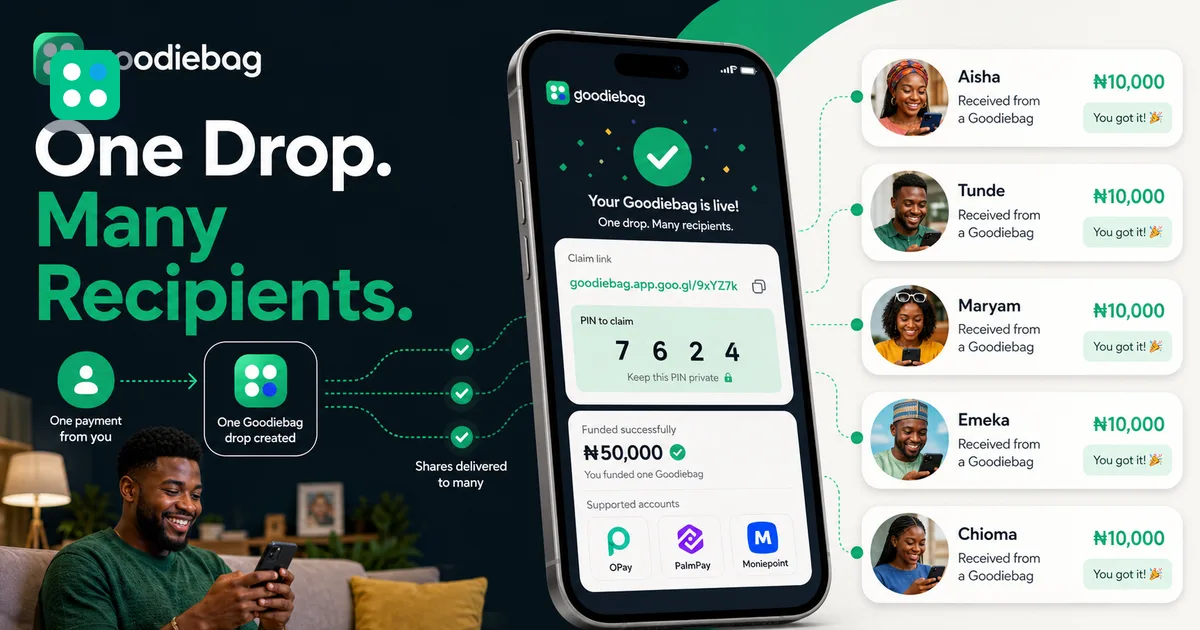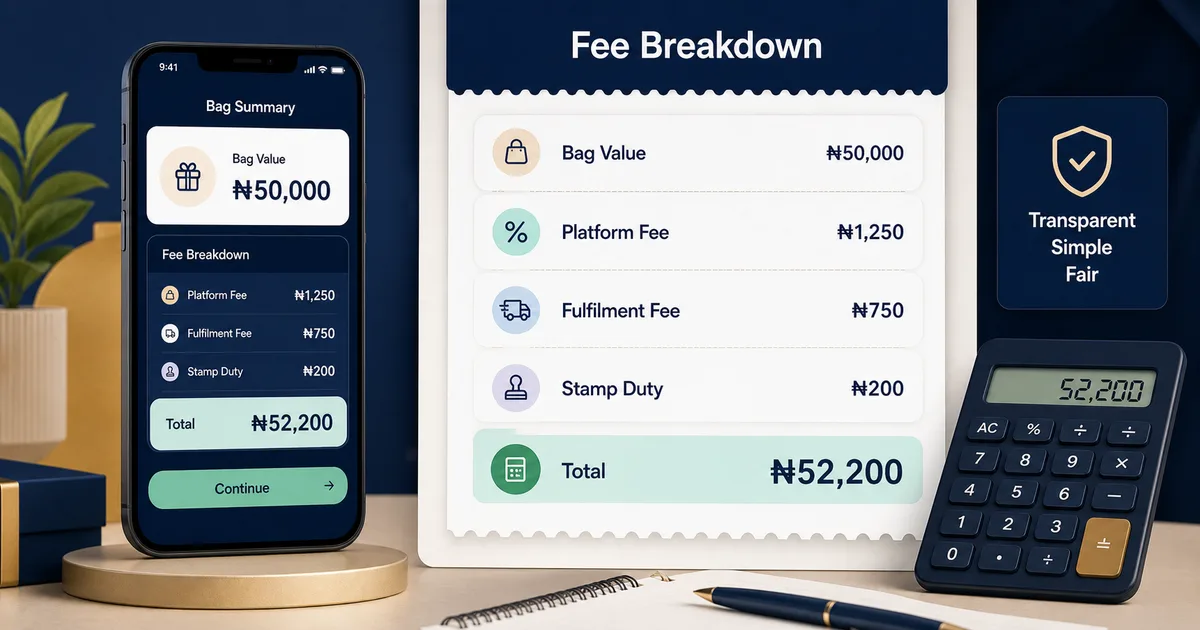
Fee questions come up every time someone creates a Goodiebag. How much extra am I paying? What does the recipient actually receive? Are there hidden charges? The answers matter because sending a cash gift should feel generous, not confusing. Goodiebag charges three types of fees: a platform fee (3 percent of the bag value, capped at ₦3,000), a fulfilment fee (₦20 for each intended recipient), and statutory stamp duty (₦50 on individual payouts of ₦10,000 or more, which recipients pay under Nigerian law). The platform fee and fulfilment fee combined are never less than ₦200. The full cost appears before you enter the Paystack checkout, so you decide with your eyes open on every parameter.
Key Takeaways - The sender pays a 3% platform fee (capped at ₦3,000) plus a ₦20 per-recipient fulfilment fee, combined never below ₦200. - Recipients pay no Goodiebag claim fee, only ₦50 stamp duty on payouts of ₦10,000 or more. - The full total is itemised before checkout at Paystack. No surprise charges. - Unclaimed funds are refunded after the Goodiebag expires (1 to 24 hours). - The platform fee stops at ₦3,000, so larger bags pay a lower effective rate.
What Do You Actually Pay When Creating a Goodiebag?
When you create a Goodiebag, you pay two fees on top of the bag value. The platform fee is 3 percent of the bag amount, capped at ₦3,000. The fulfilment fee is a flat ₦20 for each recipient slot you set. Combined, these two fees are never less than ₦200, so a very small bag pays the ₦200 minimum rather than a lower amount calculated from the percentage alone. These are itemised separately before payment, and their combined total is your service fee. Nigeria's electronic payment ecosystem handled ₦284.9 trillion in transactions during Q1 2025 alone, according to Nairametrics. That means millions of Nigerians send money regularly, and platform fees are standard across almost every payment-enabled service in the country.
Goodiebag's platform fee funds the product experience: the claim flow, the real-time activity feed, the sender dashboard, customer support, and the security infrastructure that processes every transfer. The 3 percent rate is competitive with payment platforms in Nigeria, and the ₦3,000 cap means the fee is never disproportionate for larger bags. A bag worth ₦200,000 would normally incur a ₦6,000 platform fee at 3 percent, but the cap limits it to ₦3,000. That is effectively a 1.5 percent rate on the same transaction.
See the full fees page for a complete breakdown with worked examples.
How Does the Bag Value Compare to What You Actually Pay?
A ₦10,000 Goodiebag set for 10 people costs the sender ₦10,500 total. Here is the breakdown. ₦10,000 is the bag value that recipients split. ₦300 is the platform fee (3 percent of ₦10,000). ₦200 is the fulfilment fee (₦20 per recipient for 10 people). The sender pays ₦10,500, and all recipients share the full ₦10,000. Each payout in this example is ₦1,000 (using Equal Split), which is well below the ₦10,000 threshold that triggers stamp duty.
The table below illustrates how fees scale with bag size and recipient count.
The fulfilment fee scales with the number of recipients, not the bag value. A ₦100,000 bag for 10 people costs ₦100,300 total (₦100,000 bag + ₦3,000 platform fee capped + ₦200 fulfilment fee). A ₦100,000 bag for 50 people costs ₦102,000 total (₦100,000 bag + ₦3,000 platform fee + ₦1,000 fulfilment fee). The platform fee stays capped at ₦3,000, but the fulfilment fee increases because there are more individual transfers to process. This structure makes small drops affordable and large drops predictable in cost.
At the small end, the ₦200 minimum keeps the combined fee steady. A ₦500 bag for 2 people has a platform fee of just ₦15 (3 percent of ₦500) and a fulfilment fee of ₦40, adding up to ₦55 on their own. Instead, the sender pays the ₦200 minimum, for a total of ₦700. This floor exists because processing even a tiny drop still involves real payment and payout costs, so a small fixed minimum keeps very small bags sustainable.
What Exactly Is the Platform Fee For?
The platform fee covers the Goodiebag product itself. Every time someone creates a bag, the platform processes the payment through Paystack, generates a unique claim link and PIN, manages the live activity feed where senders watch claims happen in real time, handles the sender dashboard and bag management, and provides customer support if anything goes wrong. OPay and PalmPay together handle over ₦20 trillion in mobile money transactions in Nigeria, according to TechCabal (2025). That volume proves Nigerians trust digital money movement. Goodiebag sits on top of that infrastructure to make group gifting simple.
The cap also matters for trust. A capped percentage fee means the platform has an incentive to support large drops because the revenue is predictable. It also means the sender is not penalised for running a generous giveaway. The ₦3,000 cap applies per bag, so splitting a large giveaway into multiple smaller bags does not reduce the total fee. Consolidating everything into one larger bag is the most cost-effective approach.
What Is the Fulfilment Fee For?
The fulfilment fee is ₦20 per recipient slot. It covers the cost of sending money to each successful claimant. A Goodiebag is not one transfer. It can become 2, 10, or 100 individual transfers depending on how many people claim. Each transfer requires Paystack's infrastructure to resolve the recipient's bank account and execute the transfer securely. The ₦20 per recipient makes fulfilment costs predictable: a 10-person bag costs ₦200, a 50-person bag costs ₦1,000, and a 100-person bag costs ₦2,000.
This fee structure makes the most difference for group drops. If you are sending money to 15 family members for Sallah, you would traditionally pay 15 separate transfer fees through your bank app. Goodiebag consolidates that into one upfront payment, which often works out cheaper than 15 individual bank transfer fees depending on your bank's charging structure. The ₦20 per recipient is typically lower than what most Nigerian banks charge for a single transfer to another bank.
What Is Stamp Duty and Who Pays It?
Stamp duty is a statutory charge under Nigerian law that applies to qualifying electronic money transfers. It is not a Goodiebag fee. For Goodiebag payouts, ₦50 stamp duty is triggered when an individual recipient receives ₦10,000 or more in a single payout. The recipient bears this charge, not the sender. The charge is deducted from the payout amount, so a recipient claiming ₦10,000 would receive ₦9,950 after stamp duty deduction.
The ₦50 stamp duty on electronic receipts of ₦10,000 and above is a government-mandated charge established under the Stamp Duties Act. It applies broadly across Nigeria's financial system, not just on Goodiebag. Traditional banks also deduct this charge on deposits above ₦10,000. A 2024 NIBSS report noted that electronic payment transactions in Nigeria have grown consistently, with stamp duty collection being a standard part of the payment infrastructure for qualifying transactions. Goodiebag clearly states when stamp duty may apply rather than deducting it silently. You can read more on the Goodiebag fees page.
What Do Recipients Actually Pay?
Recipients pay nothing to Goodiebag for claiming a share. There is no claim fee, no membership charge, and no Goodiebag wallet withdrawal cost. The only potential deduction is the ₦50 stamp duty on individual payouts of ₦10,000 or more, and that is a government charge, not a Goodiebag one. For most Goodiebag drops where individual shares are below ₦10,000, successful claims are processed to the recipient's OPay, PalmPay, or Moniepoint account without a Goodiebag claim fee.
Read Also
This zero-fee-for-recipients model is intentionally different from how most traditional platforms work. Many Nigerian banks charge recipients for receiving transfers through SMS alert fees and stamp duty. Some fintech platforms charge for expedited settlement. Goodiebag's model keeps the cost on the sender, who is the one making the active choice to give. The recipient's experience is simple: they open the link, enter the PIN, and successful claims are processed through supported payment partners. No sign-up, no Goodiebag claim fee, no wallet withdrawal step.
What Happens to Unclaimed Funds?
Goodiebags expire after the sender's chosen duration, which can be set between 1 and 24 hours at creation. After expiry, unclaimed funds are normally refunded to the sender through Paystack. The refund is processed back to the sender's original payment method, subject to Paystack, bank, card network, fraud, compliance, and technical processing. Refund timing may vary depending on the sender's bank and payment method.
The terms of service cover refund policy and expiry details.
The expiry system means you are never charged for recipients who do not participate. If you set a bag for 20 people and only 12 claim within the time window, the remaining 8 slots are refunded. This is a practical advantage over collecting manual bank transfers where you might commit the full amount upfront without knowing who will show up.
Why Is the Full Price Shown Before Payment?
Goodiebag displays the complete cost breakdown before checkout so senders see exactly what they are paying for. The bag value, the platform fee, the fulfilment fee, and the total due are all itemised before the Paystack payment page loads. This transparency is deliberate. Cash gifting involves trust, and the first step to earning that trust is showing the full cost upfront with no hidden line items.
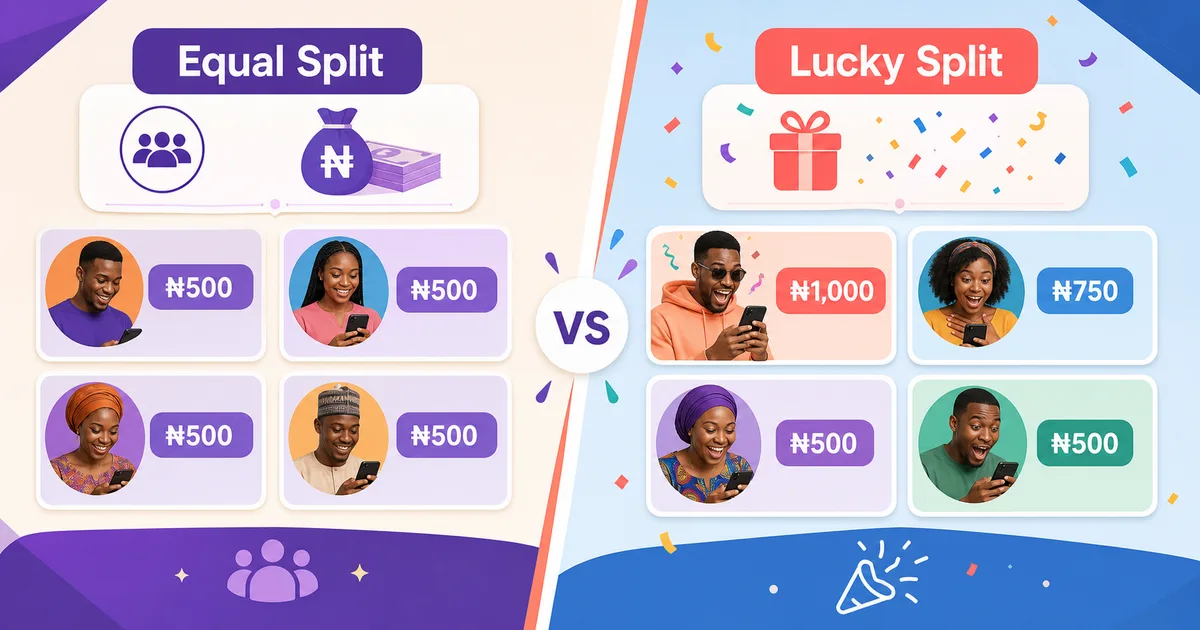
The dynamic minimum per recipient also adjusts based on your settings. The create page calculates the minimum automatically depending on the total amount, number of recipients, and split mode. For Equal Split, the minimum per person is higher. For Lucky Split, individual minimums are lower but each slot is still covered. This calculation is displayed in real time so you never enter checkout wondering if you have configured the bag correctly. You can test the numbers yourself on the create page.
Frequently asked questions
Who pays the Goodiebag fees?+
The sender pays the platform fee (3% capped at ₦3,000) and the fulfilment fee (₦20 per recipient) when creating the bag, combined never less than ₦200. If an individual payout is ₦10,000 or more, the statutory ₦50 stamp duty is borne by the recipient under Nigerian law.
Do recipients receive less than the amount shown?+
Goodiebag does not charge recipients any claim fee. For payouts below ₦10,000, recipients receive the full claimed amount. For payouts of ₦10,000 or more, the ₦50 stamp duty is deducted from the payout. Bank or payment partner charges may also apply where required.
What is stamp duty on Goodiebag?+
Stamp duty is a government charge under the Stamp Duties Act that applies to electronic money transfers of ₦10,000 or more. When a Goodiebag recipient receives ₦10,000 or more, the ₦50 stamp duty is deducted from their payout. This is not a Goodiebag fee.
Why is there a per-recipient fulfilment fee?+
A Goodiebag can turn into many individual transfers, one for each successful claimant. The ₦20 per-recipient fee covers the cost of processing each payout through Paystack. It is typically lower than what most Nigerian banks charge for individual transfers.
What if some people do not claim?+
Goodiebags expire after the sender's chosen duration (1 to 24 hours). Unclaimed funds are normally refunded to the sender after expiry, subject to Paystack, bank, and card network processing timelines.
Is there a minimum fee?+
Yes. The platform fee and fulfilment fee combined are never less than ₦200, even on a small bag where 3% plus ₦20 per recipient would otherwise add up to less. This minimum applies whether or not a fee waiver or promotional offer is active.
Create your first Goodiebag
Create a money packet in under 2 minutes. One link. One PIN. Everybody paid.
Create a GoodiebagWant to send your own? Head to Goodiebag and set one up in minutes.
Goodiebag Editorial Team
Goodiebag product and safety team
Guides by the Goodiebag team on social cash gifting, supported payouts, sender safety, and practical digital reward use cases in Nigeria.
Start your first Goodiebag today
Fund a drop, share a link and PIN, and let your audience claim while the moment is live. No Goodiebag account needed for recipients.
Create a Goodiebag